

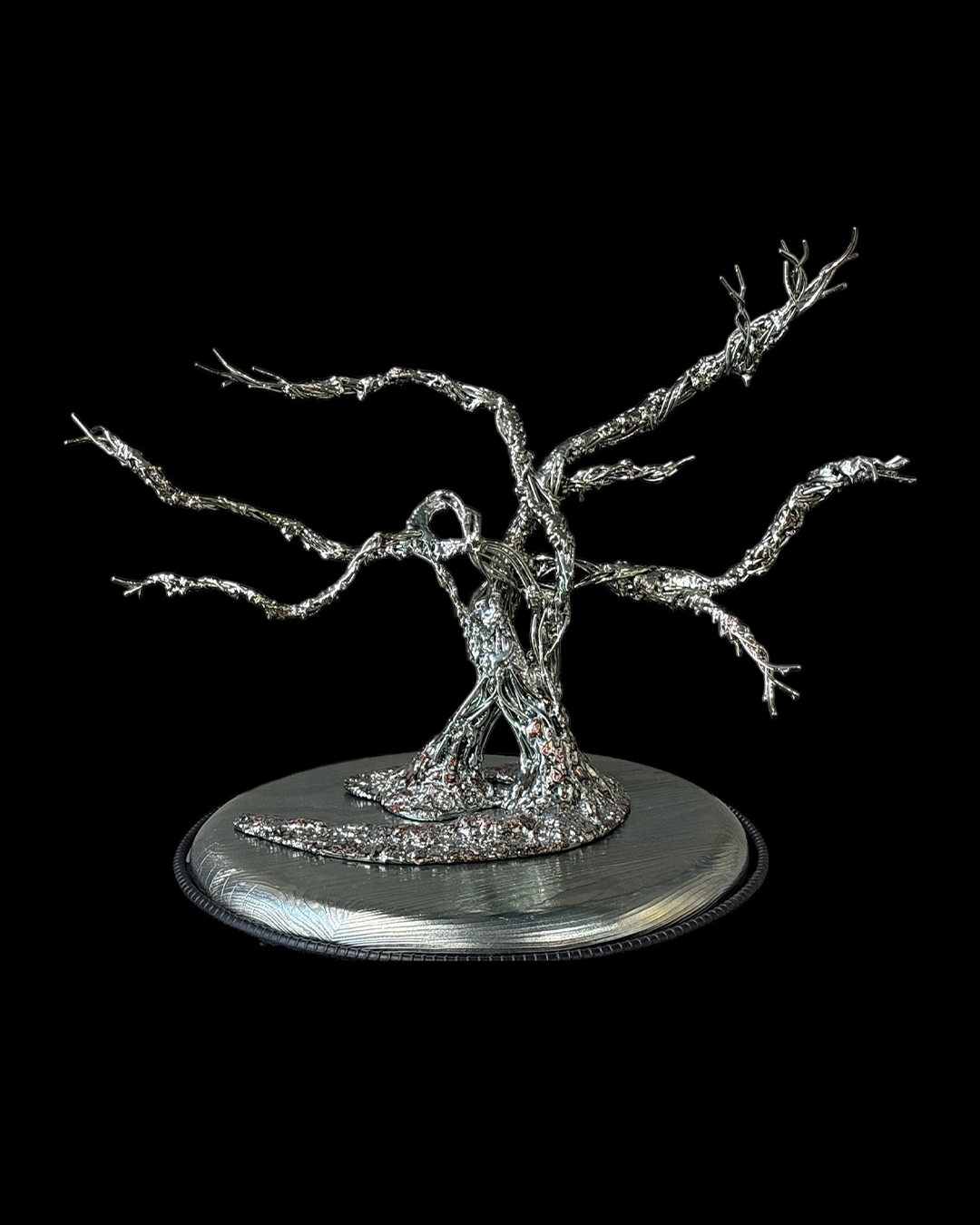
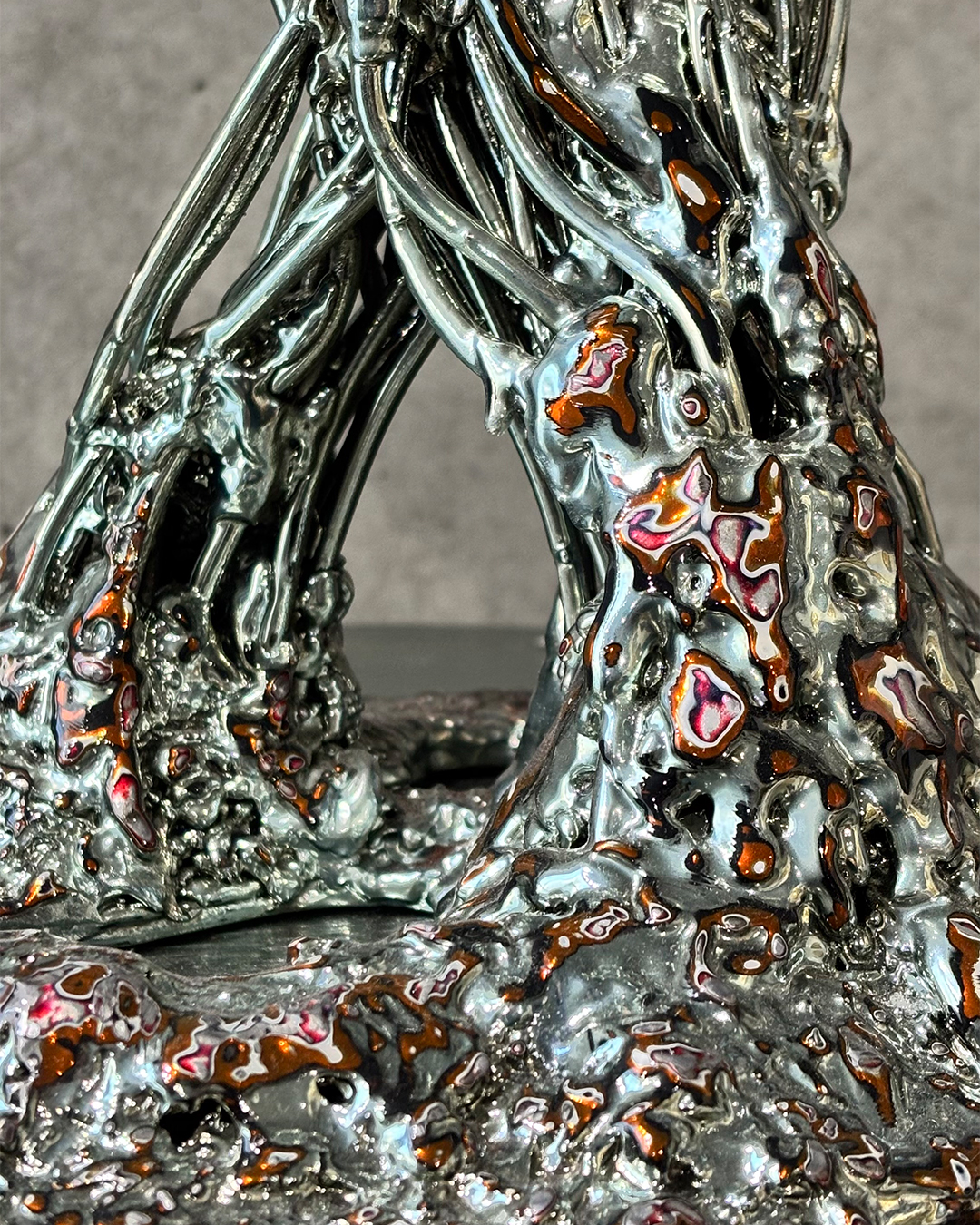
No-Thingness
¥2,970,000 (tax incl.)
幅:71cm
高さ:52cm
素材:特殊ハンダ, 鉄製針金, 銅線
Width: 71cm
Height: 52cm
Materials: Special solder, Steel wire, Copper wire
クワイ華の言葉:
「こちらのオブジェですが、特殊ハンダを使用して台座や幹、枝の部分の肉盛りをしています。通常のハンダは熱が掛かると水の様に流れてしまいますが、この特殊ハンダはご覧の通り粘土の様にモリモリ盛り上げる事が出来ます。この特殊ハンダは1930年頃までは全世界的に例えば車のボディーの鉄板同士をくっつける為に、とにかく製造業の間で使われていた古の板金加工技術なのですが、1930年台の後半、溶接の技術が飛躍的に進化しその需要は一瞬にして消え去りました。現在の日本でこの特殊ハンダの存在を知る人は殆どおらず、故、この特殊ハンダを実際の製造現場で使用している企業や会社は10本の指で数える程度だと思います。
ドイツにトーマス・ハバーマンと言うハーレーのカスタムビルダーが居ます。彼は金造造形や板金造形における神様の様な人で物凄いセンスと技術を持ち合わせた人物です。2000年の初め頃、ドイツで彼を知り合う機会に恵まれ、その後2010年まで年に2〜3回程はドイツの彼の元に赴き、様々な技術や試式の教えを乞いました。そのトーマスが最も得意としていた造形技術がこの特殊ハンダを用いた金属造形でありまして、ハンダにおける金属の配合率や特殊ハンダを使用する前準備の施工方法の全てを彼から直接学びました。BAD LANDではトーマスの教えを最大限尊重しつつ、実際のカスタムハーレーの製作に取り入れておりましたが、特殊ハンダが見せる独特の表情や佇まい、また可能性に関しては、カスタムバイクの製作などと言う小さな世界だけで済ませてしまうには余りにも勿体無いと言う感覚を即覚えつつ、アート的なアプローチに大いに使える事を直感致しておりました。
本格的にアート的なコンセプトでこの特殊ハンダに取り組むまでには相当の時間が掛かりましたが、本作品はその第一号になるかと思います。特に台座部分に見えるオレンジ色ですが、これはまず特殊ハンダにより全体の造形を行います。特殊ハンダは銀色をしています。その特殊ハンダの銀色を下地カラーとして、透け感のあるオレンジクリアーを塗装します。オブジェ全体を一度キャンディーオレンジに染め上げた後、UNDULATIONでお馴染みのナノ銀特殊塗料を塗装。
オブジェ全体をキャンディーオレンジからメッキの色に戻した後、バフを言う道具を用いてナノ銀特殊塗料による銀の塗膜を部分的に削り取り、その下にあるキャンディーオレンジの色を出現させています。一見メッキの表面に見える台座ですが、所々オレンジ色が見えている。 これは金属を対象とした最終表面処理に携る人でしたら驚愕以外の何物でもありません。
古の金属加工技術である特殊ハンダが見せる独特の丸味を帯びた形状 / その最終表面処理に使用した最先端の化学技術であるナノ銀特殊塗料による塗装。19世紀にイギリスで起きた産業革命を起源とする一連の金属系工業技術の連綿とした歴史が、実はこのオブジェには込められているのです。」
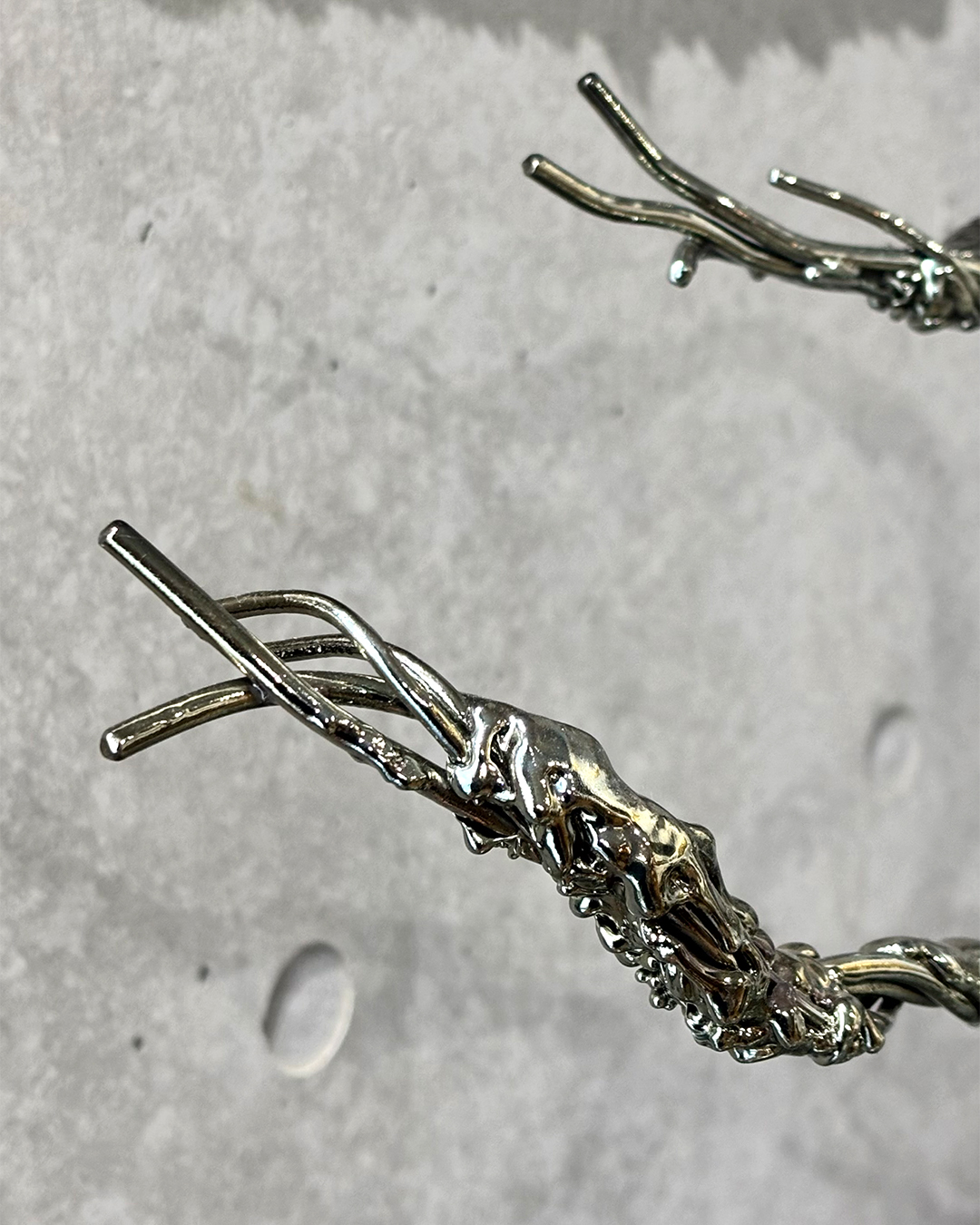
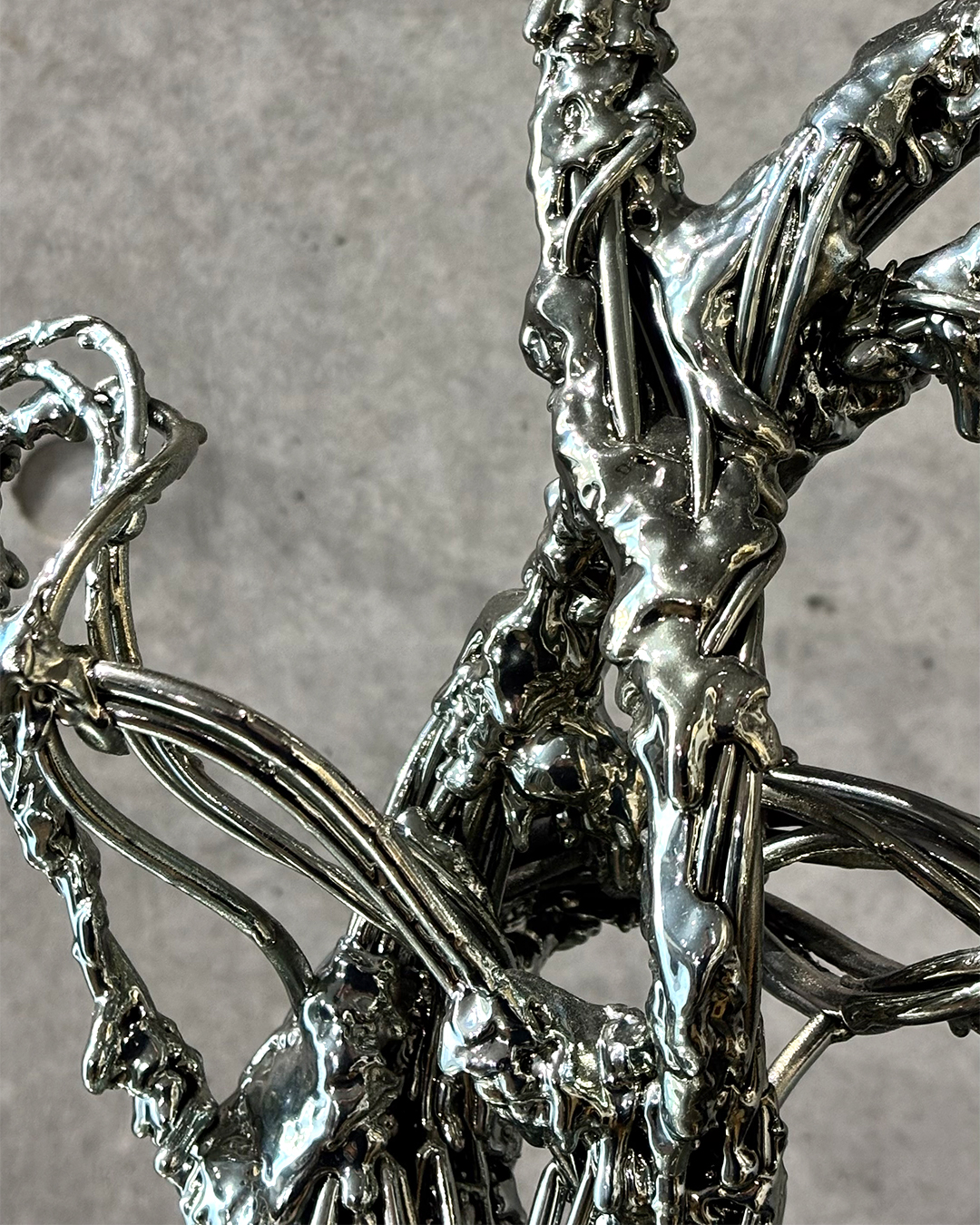
This object is constructed by building up material on the base, trunk, and branches using a special solder. Ordinary solder liquefies and flows like water when heat is applied, but this special solder behaves very differently: as you can see, it can be built up thickly, almost like clay, allowing forms to be sculpted with volume and presence.
This special solder is an ancient sheet-metal forming technique that was widely used throughout the manufacturing world until around the 1930s—for example, to join steel panels in automobile bodies. However, in the latter half of the 1930s, welding technology advanced dramatically, and the demand for this technique disappeared almost overnight. Today in Japan, very few people are even aware of the existence of this special solder, and it is estimated that only a handful of companies—perhaps fewer than ten—still use it in actual production settings.
In Germany, there is a custom Harley-Davidson builder named Thomas Habermann. He is a figure revered almost like a god in the fields of metal sculpture and sheet-metal forming, possessing extraordinary sensibility and technical mastery. In the early 2000s, I was fortunate to meet him in Germany, and until around 2010, I visited his workshop two to three times a year to learn various techniques and experimental methods directly from him.
The technique Thomas excelled at most was metal sculpting using this special solder. I learned from him firsthand every aspect of it: the metal composition ratios of the solder itself, as well as all preparatory processes required before its application. At BAD LAND, we incorporated his teachings with the utmost respect into the production of custom Harley-Davidson motorcycles. However, the unique surface expressions, presence, and latent possibilities revealed by this special solder felt far too compelling to be confined to the relatively small world of custom motorcycle building. I instinctively sensed that it could be powerfully expanded into an artistic approach.
It took a considerable amount of time before I fully committed to exploring this special solder within a genuine artistic concept, but I believe this work represents the very first result of that pursuit.
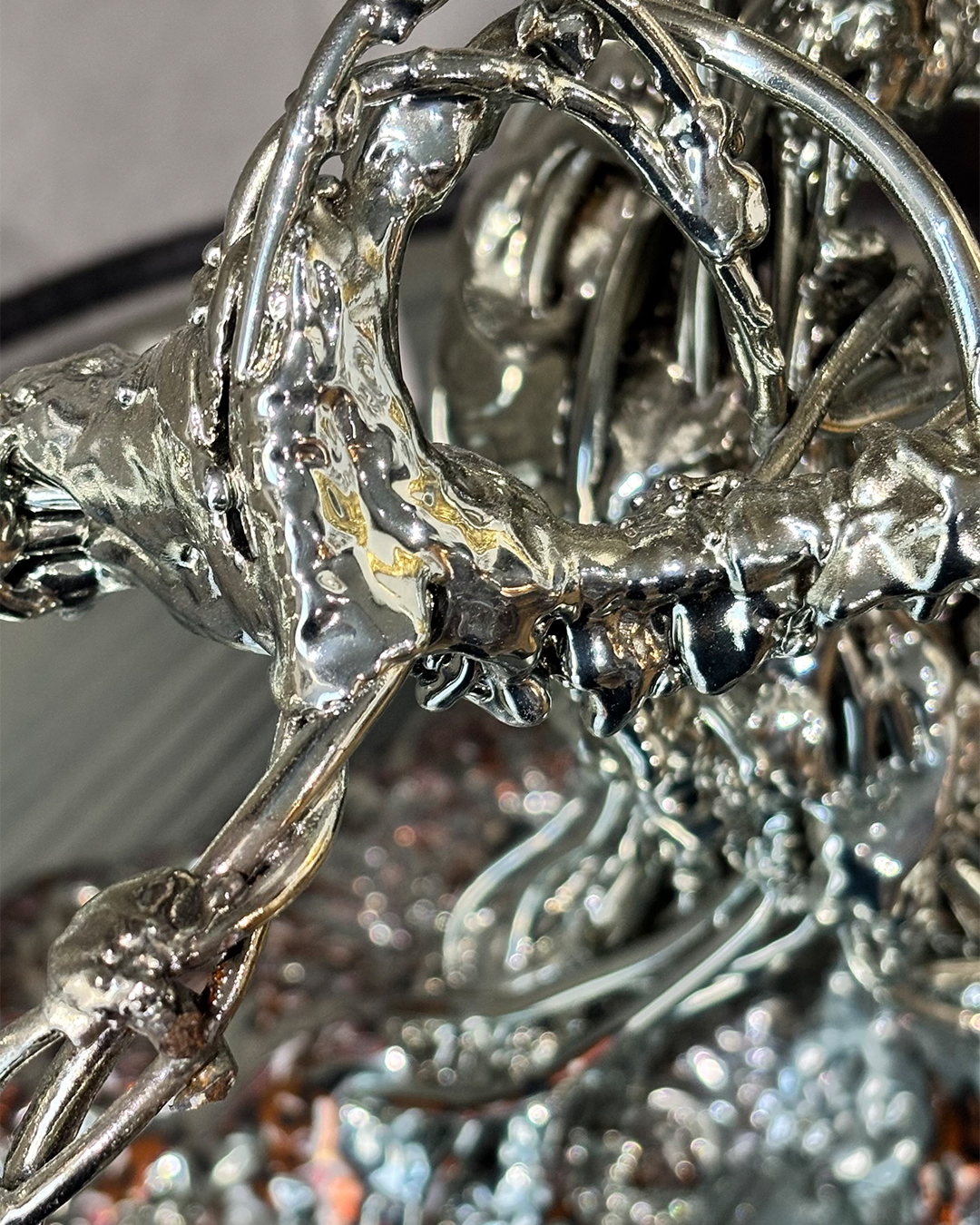
The orange color visible in the base is particularly noteworthy. First, the entire form is sculpted using the special solder, which has a silver appearance. This silver surface is then used as a base color, over which a translucent orange clear paint is applied. After the entire object is dyed in candy orange, it is then coated with UNDULATION’s signature nano-silver special paint.
Once the object is returned from its candy-orange state to a plated, metallic appearance, a buffing tool is used to partially remove the silver paint layer created by the nano-silver coating. Through this process, the underlying candy-orange color is selectively revealed. At first glance, the base appears to be a standard plated surface—yet flashes of orange can be seen emerging in places. For anyone involved in final surface finishing of metal, this effect is nothing short of astonishing.
The softly rounded forms created by this ancient metalworking technique using special solder, combined with the final surface treatment achieved through cutting-edge chemical technology in the form of nano-silver special paint—within this object resides a continuous lineage of metal-based industrial technologies whose origins trace back to the Industrial Revolution in 19th-century Britain. This long and evolving history is, in fact, embedded within this work itself.
― Kuwai Hana